
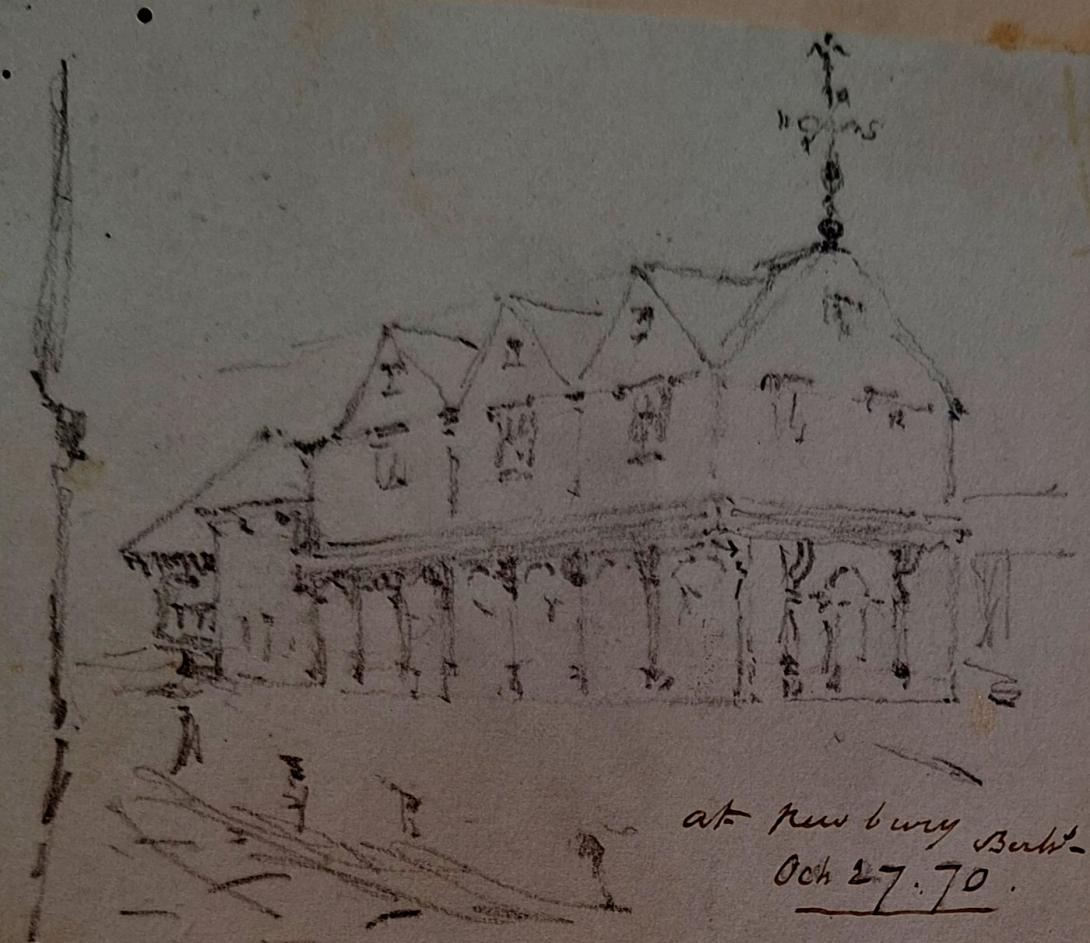
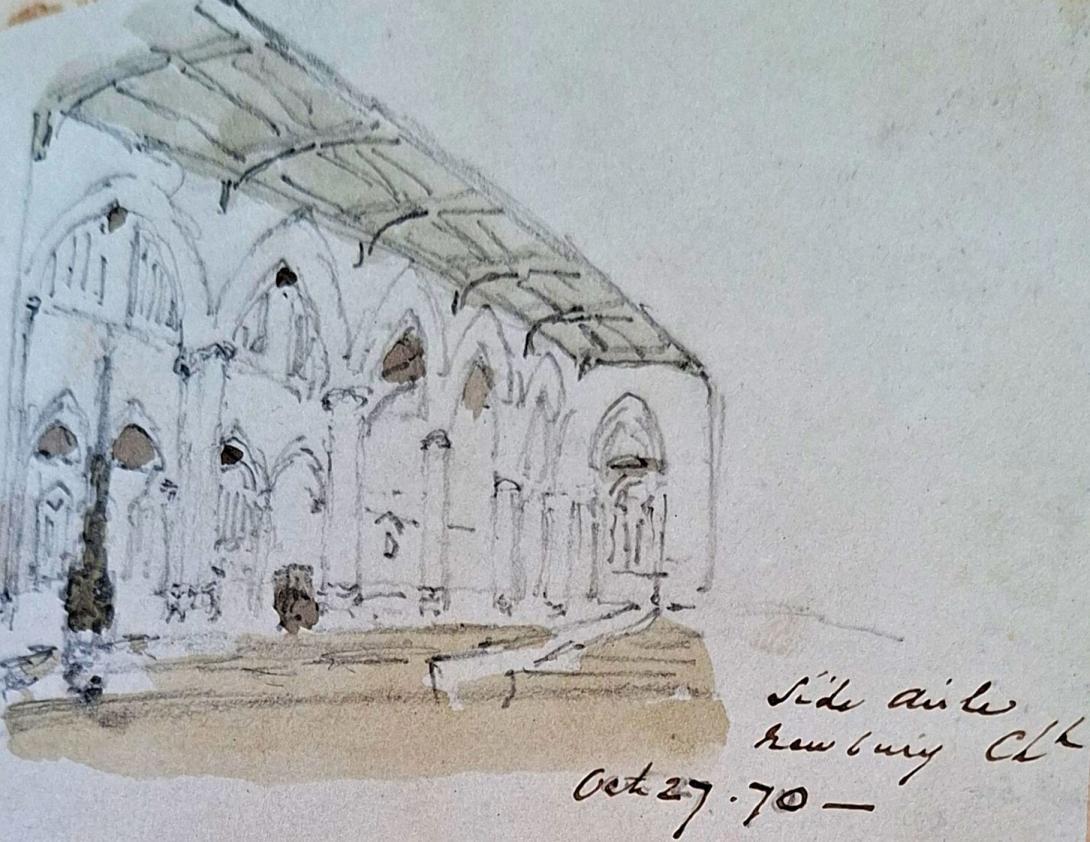
at Newbury Bucks Oct 27 70
Newbury Town Hall is a municipal building in the Market Place in Newbury, Berkshire, England. The building, which is the meeting place of Newbury Town Council, is a Grade II listed building.
The site for the first town hall in Newbury had been occupied by several properties belonging to a Mr Thomas Stockwell. Originally referred to as the "town house", it was designed by John Wood of Bath and constructed in the Market Place by a local building firm, Clarkes, and completed in 1742. The building was arcaded on the ground floor so markets could be held and there was a room known as the "great hall" on the first floor. Subsequent acquisitions for use in the great hall included two chandeliers, financed by a donation, in 1770 and two paintings by the Italian artist, Cosino Fioravante, in 1776.
In 1825, the UK Parliament passed the Newbury and Speenhamland Improvement Act, which, among other matters, contemplated a new town hall to replace "the ancient building then standing in the Market Place".The foundation stone for the new "municipal buildings" was laid by the mayor, William George Adey, on 30 August 1876. The structure was designed by James H. Money in the Gothic style and officially opened by the Earl of Carnarvon on 7 May 1878. The new municipal buildings were enhanced by the erection of a clock tower, which was financed by a public subscription campaign organised by the mayor, James Benjamin Stone, and completed in 1881.The Cambridge-chiming clock was designed and manufactured by Potts of Leeds.
The design involved an asymmetrical main frontage with five bays facing onto the Market Square; the central section of three bays, which were gabled, featured two-light arched windows on the first floor. The left hand bay featured a tower and the right hand bay featured a doorway on the ground floor with a balcony and a tall four-stage clock tower above.Internally, the principal room was the council chamber at the front of the building on the first floor.
The original town house was demolished in 1908 to make way for an extension to the rear, in a similar style to the municipal buildings, which was completed in 1910. During the First World War the town hall acted a recruiting base for potential soldiers for Kitchener's Army. It continued to serve as the headquarters of the municipal borough of Newbury for much of the 20th century and remained the local seat of government when the enlarged Newbury District Council was formed in 1974. However, it ceased to be the local civic meeting place when the district council moved to the Council Offices in Market street in 1980.
A plaque was installed on the town hall to commemorate the visit by Queen Elizabeth II, to celebrate the 400th anniversary of the granting of a Royal Charter, on 25 October 1996. The building then became the home of Newbury Town Council when it was formed in 1997.
Works of art in the town hall included portraits by Allan Ramsay of King George III and of Queen Charlotte.
St Nicolas Church is the Church of England parish church of Newbury, Berkshire, and stands just south of the main bridge over the River Kennet, in the centre of the town. The Grade I listed building is chiefly remarkable for the consistency of its Perpendicular Gothic architectural style and its unusually large size for a parish church.
It remains a lively and active church with a congregation of around 260.
St. Nicolas Church is dedicated to the eponymous Bishop of Myra in the fourth century. A church was first built in this site during Norman times, and it is mentioned in a document of 1086 in which Ernulf of Hesdin gives the church of the Abbey of Préaux.
The present parish church was entirely rebuilt, probably between the years 1509 and 1533. It is in the architectural style of the late Perpendicular period. The presence of certain devices in the stonework, in particular the pomegranate device (the apple of Grenada) and the portcullis device (which appears on the Tudor royal escutcheon) indicates that the church was built during the marriage of Henry VIII and Catherine of Aragon, which ended in divorce in 1533.
In Fuller's History of the Worthies of England, published in 1663, it is stated: "John Winchcombe, commonly called Jack of Newbury... built the church of Newbury, from the pulpit westward to the tower inclusively, and died about the year 1520".
Although the church was extensively restored by the Victorians, they made no major structural alterations. It was designated as Grade I listed in 1950.

The plan of the church is typical for a parish church, consisting of nave and chancel with no transept. Considered large compared to other churches of the same style, the nave has a clerestory, lighted by five large three light windows on either side, and aisles with arcades of five arches each. These aisles open into what were chantry-chapels on either side of the chancel. The southern chantry-chapel still has that role, but the northern is used as a vestry and contains the organ.
The west tower has a peal of ten bells and a Sanctus bell. The back eight bells date from 1803 and were cast from the now defunct Wells of Aldbourne bell foundry; they were re-hung in 1933 with new fittings and were augmented from 8 to 10. The front two date from 1933 and were cast by Mears & Stainbank of Whitechapel Road, London. The tenor bell, which weighs 21-2-1 (1093 kg), is in the note of D.
The stained glass windows date from the Victorian restoration by Henry Woodyer as do the external crenellations along the roof-line, and the pinnacles and turrets of the tower.The stained glass windows installed for this restoration were manufactured by Hardman & Co., the largest number being designed by John Hardman-Powell with some later ones designed by Donald Taunton. There is a Jacobean pulpit dating from 1607.
Richard Suter was born in Greenwich, Kent on 30th March 1798, to William Suter and his wife Sarah Knights. On 7th January 1825 he married Anne Ruth Burn.
English architect. As Surveyor to The Fishmongers' Company he designed the severe Presbyterian churches for Ballykelly (1825–7) and Banagher (1825) on the Company's Estate in County Londonderry, drawings of which were exhibited at the Royal Academy in 1827. He was also responsible for the Model Farm (1823–4), the Lancasterian Schools (1828–30), the Company Agent's House (1830–2—now a hotel, much altered), a range of houses on the south side of the main road (1823–4), the lodge in the Presbyterian churchyard (1828), and the Dispensary (1829), all at Ballykelly, and all Classical. As Surveyor to Trinity House Corporation, he designed houses that were erected by Thomas Cubitt in 1821–3 on a site adjoining Trinity House. For The Fishmongers' Company he designed St Peter's Almshouses, Wandsworth, London (1849–51), and The Old School-House, Gresham's School, Holt, Norfolk(1859), in an Elizabethan style.
On the 1841 Census Richard, an architect and lawyer, can be found living in London with his wife Ann (listed as Ruth) and their two children, Richard George and Andrew Burn. Living with them is Edward D Suter. 1851 finds the family living in Tottenham Court in London, by this time Andrew had left the home, but I am unable to trace him on the 1851 Census. In 1860 Andrew marries Amelia Damaris Harrison. Both Richard George and Andrew were to become ordained ministers, with Andrew later becoming a Bishop and emigrating to New Zealand. Sadly in 1854 Anne Ruth was to pass away. In 1861, widowed Richard, Justice of the Peace for Maidenhead, is living at Castle Hill, Maidenhead, Berkshire. In 1862 he married Elizabeth Anne Pocock. In 1871 and 1881 Richard and Elizabeth are still living in Castle Hill. Richard was to pass away on 1st March1883.
Richard Suter & Annesley Voysey, architects, had their office at number 35 Fenchurch Street, but they did not have it all to themselves as they shared the premises with W.C. Franks, a tea broker, who will get a separate post some other time. The earliest mention I found of Richard Suter in Fenchurch Street is in 1832 when he is listed at that address in a list of contributing members of the Society for the Propagation of the Gospel in Foreign Parts. It says that he had been a member since 1829, but that does not mean he was already at 35 Fenchurch Street in that year. In fact, that seems unlikely as the Sun Fire Office records give Messrs. Short and Co., merchants, as paying the insurance premium on the premises in May 1830. The Directory of British Architects 1834-1914 give the year 1827, but I do not know on what evidence. When Suter and Voysey became partners is also uncertain, but they had known each other since at least 1825 as Suter is named as one of the executors of Voysey’s will which was dated 22 July, 1825. The address given for Suter in the will is Suffolk Street, Southwark. Voysey then lives at Conway Street, Fitzroy Square.