
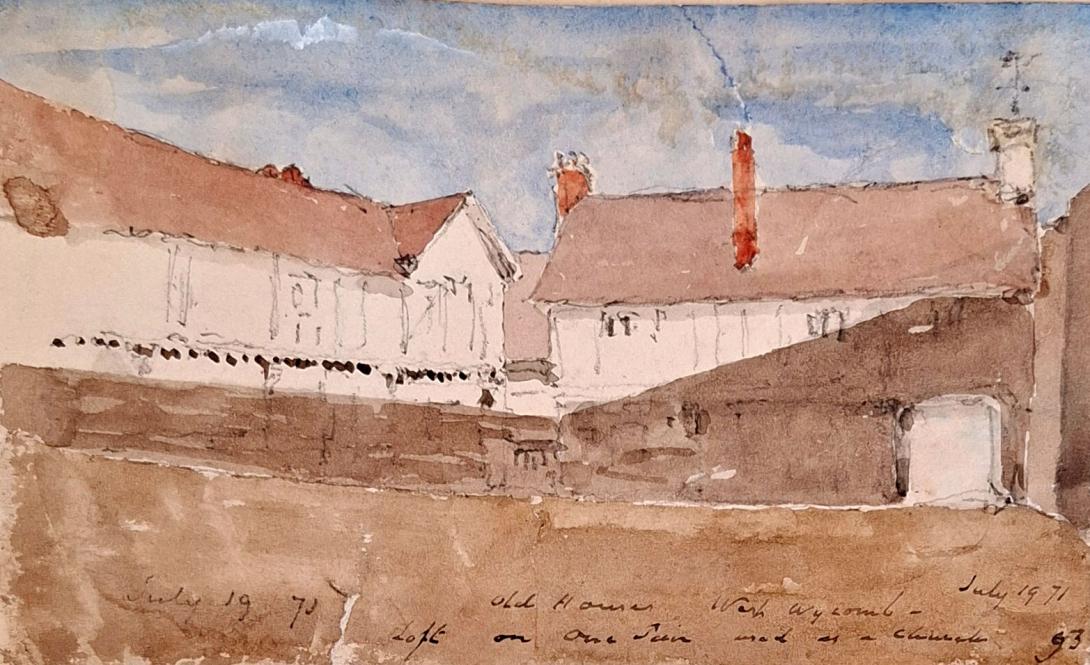
Old Houses West Wycombe July 19th 1871 Loft on one Pain and as a church
The Church Room and Loft on the High Street is the oldest building in the village dating back to the 15th century . The Church Loft is thought to be the oldest surviving building in West Wycombe village with dendrochronology dating suggesting 1465 for its construction. Situated in a prominent location
on the north side of the High Street it has a fascinating history reflecting changing patterns of social, domestic and commercial activity in the village over a period of more than 500 years. ‘Church Loft’, situated on the north side of the High Street. This is in the ownership of the Diocese, and as the oldest dated building in the village it represents a significant omission from the Trust’s survey.
The earliest building recorded by the1990s survey is the Old Vicarage on the east side of Church Lane (Fig. 3), built originally as a Priest’s house
and dating from the early to mid-15th century (Garside, Izzard & Waters 1992). Though enlarged in the 17th and 18th centuries the original core of
a two bay open hall with two-storey single bays at either end can still be traced. The relatively high status of the building is illustrated by the use of
a decorated arched-braced open truss in the open hall. The recent dendrochronology dating of the Church Loft to 1465 suggests, however, that these two buildings may be near contemporary and can probably be joined by a third building, the jettied 37 High Street (the ‘Sweet Shop’), which has been
given a tentative dendrochronology date of winter 1469/70 based on a single sample returning a felling date (Fig. 5). This cluster of 15th century buildings suggests that the east end of the village may have been the focus for the late medieval village, with subsequent expansion westwards along the High Street and north up Church Lane.
The Loft is chiefly constructed of wood and plaster. Overhanging upper story. Upper room used as a Sunday School and for Divine Service in inclement weather. Turret contains clock and bell. 1 of the wooden posts of the gateway has a cross indented in and another has the old handcuffs of the village stocks nailed to it. Until recently a room on the ground floor was used as a lock up.
Building supposed to have been erected by the Monks of Bisham Priory sometime after 1417. On the ground floor are distinct traces of 4 cells, perhaps used by the Monks. Restored in1676. (The name of the) Restoring architect (was) d'Caroe. The Church Loft, a late 15th century house of 2 storeys, of timber and brick, partly renewed at various dates. At north end is a small weather boarded bell turret, probably of 17th or 18th century . Rectangular plan with open passage at West end. Building is a good example of this type of medieval structure.
Late C15. Original timber frame, later red brick nogging, old tiled roof with square wood early C18 bell turret carrying weather vane. 2 storeys, 1st floor oversailing on 5 brackets and moulded beam; ground floor divided by posts and brackets into 3½ bays, left hand bay open and forming a carriage- way to Church Lane. 2 ground floor doors and 6 casements, partly modern and partly restored, all with timber 4 centred pointed arches, 4 leaded 1st floor wood mullion casements, 3 light except on right hand side 2 light, all modern but with some old glass. Interior of 1st floor said to contain open Queen post roof, V.C.H., III, p135; R.C.H.M; p 519. Nos 35 to 37 (consec), The Church Loft, Nos 45 to 54 (consec), Nos 56 to 59 (consec) The Manor House, The Plough Inn, Premises occupied by Frank Hudson, The Old Smithy, West Wycombe Estate Office, Rose Cottage and Ness.
The Benefice of West Wycombe was bestowed on the monastery at Bisham Priory in 1417. It is thought that it was the who erected this building sometime during the latter part of the fifteenth century. It is easily the oldest building in the village. Originally there were two carriageways, one at each end; this can be seen by looking at the external timber work. Since the moulding of the beam which supports the upper story at the rear of the
building stops short of the west end, there may well have been an external set of stairs at this point. The centre part of the building was divided into four ‘cells’ by wattle and daub partitions, each having its own external door, presumably used by either monks, pilgrims or travellers. A large fireplace was built when the Eastern End carriageway was enclosed in order to act as a communal room. At the East End, facing the High Street, there is a hollowed-out cross-shaped recess upright in the timber; this would have contained a crucifix, and below this, the foundation boulder is hollowed where a pilgrim could kneel at this wayside shrine.
At the other end of the building, beyond the carriageway, are the remains of a metal shackle attached to the timber, it being all that is left of a whipping post to punish offenders. The fireplaces and the parish lockup next to the carriageway are later additions. The door to the lockup can be seen under the arch and the second door gives access to the present stairway to the Church Loft. There is a wooden plaque in memory of the late Peter Harris, who cared for the clock for many years. The clock, which projects out into the High Street and is such a feature of the village, has a face dating from 1861. But the clock itself dates from about two centuries before that. The date on the bell which strikes the hours is 1668. It is said that, in the early part of the nineteenth century, one offender incarcerated in the lockup escaped by climbing up the clock chains. This sped up the ticking of the clock, and he was forever after known as ‘Ticky Biggs’. The building was restored in 1676 and used by poor widows in the eighteenth and nineteenth centuries. It was then used for chairmaking but was in a very dilapidated state by 1900. It was restored again in 1914, and the date is inscribed on one of the internal timber pillars as well as the initials of the Churchwardens at the time, and the internal divisions were removed.
Belgian refugees were housed in The Church Room during the First World War. And in the Second World War, it was used for evacuees from London, despite the lack of water and sanitation. Since then, it has been used as a church room for meetings, services and a Sunday School. Around 1980 water was laid on and one corner was fitted out as a kitchen in order to serve refreshments. The upper storey consists of one large room and a small cupboard room at the Eastern End, and a clock room at the Western End. During the 1676 restoration, a plaster ceiling was fixed, which obscured the roof beams; this was removed in 1965 when the roof was retiled, revealing the original rafters and trusses. The roof structure includes queen-post supports, with winding braces and arched braces: a moulded beam was removed from beneath the truss beams at one time, presumably to increase the height, but a short section remains on one beam.
Some have suggested that ‘old ships timbers’ were used but there is no evidence of this. Dendrochronological tests have dated these timbers as being felled between 1420 and 1460. On the north side of the building, some timbers have been renewed over the years but much of the roof remains as it was built. The long horizontal beam dates from the 1676 restoration, and the notches for the ceiling rafters are clearly visible along it. The bishop of Winchester was a former ‘Lord of the Manor’ and was a presumed visitor after the estate passed to Bisham Priory. He is said to have ‘held court’ in this upper room. It has served to Vestry and Poor Law Trustees meetings, as well as other local meetings. The West Wycombe Parish Council continued this long tradition by using the downstairs room for their meetings. St. Paul’s Church nearby was built in 1874, and before this, the upper room was used for worship when the weather was bad. The curious ‘reading desk’ looks very much like a part of a three-decker Pulpit.
Richard Suter was born in Greenwich, Kent on 30th March 1798, to William Suter and his wife Sarah Knights. On 7th January 1825 he married Anne Ruth Burn.
English architect. As Surveyor to The Fishmongers' Company he designed the severe Presbyterian churches for Ballykelly (1825–7) and Banagher (1825) on the Company's Estate in County Londonderry, drawings of which were exhibited at the Royal Academy in 1827. He was also responsible for the Model Farm (1823–4), the Lancasterian Schools (1828–30), the Company Agent's House (1830–2—now a hotel, much altered), a range of houses on the south side of the main road (1823–4), the lodge in the Presbyterian churchyard (1828), and the Dispensary (1829), all at Ballykelly, and all Classical. As Surveyor to Trinity House Corporation, he designed houses that were erected by Thomas Cubitt in 1821–3 on a site adjoining Trinity House. For The Fishmongers' Company he designed St Peter's Almshouses, Wandsworth, London (1849–51), and The Old School-House, Gresham's School, Holt, Norfolk(1859), in an Elizabethan style.
On the 1841 Census Richard, an architect and lawyer, can be found living in London with his wife Ann (listed as Ruth) and their two children, Richard George and Andrew Burn. Living with them is Edward D Suter. 1851 finds the family living in Tottenham Court in London, by this time Andrew had left the home, but I am unable to trace him on the 1851 Census. In 1860 Andrew marries Amelia Damaris Harrison. Both Richard George and Andrew were to become ordained ministers, with Andrew later becoming a Bishop and emigrating to New Zealand. Sadly in 1854 Anne Ruth was to pass away. In 1861, widowed Richard, Justice of the Peace for Maidenhead, is living at Castle Hill, Maidenhead, Berkshire. In 1862 he married Elizabeth Anne Pocock. In 1871 and 1881 Richard and Elizabeth are still living in Castle Hill. Richard was to pass away on 1st March1883.
Richard Suter & Annesley Voysey, architects, had their office at number 35 Fenchurch Street, but they did not have it all to themselves as they shared the premises with W.C. Franks, a tea broker, who will get a separate post some other time. The earliest mention I found of Richard Suter in Fenchurch Street is in 1832 when he is listed at that address in a list of contributing members of the Society for the Propagation of the Gospel in Foreign Parts. It says that he had been a member since 1829, but that does not mean he was already at 35 Fenchurch Street in that year.(1) In fact, that seems unlikely as the Sun Fire Office records give Messrs. Short and Co., merchants, as paying the insurance premium on the premises in May 1830. The Directory of British Architects 1834-1914 give the year 1827, but I do not know on what evidence. When Suter and Voysey became partners is also uncertain, but they had known each other since at least 1825 as Suter is named as one of the executors of Voysey’s will which was dated 22 July, 1825. The address given for Suter in the will is Suffolk Street, Southwark. Voysey then lives at Conway Street, Fitzroy Square.